
There’s a moment in every Direct Primary Care practice when the question stops being “will this work” and becomes “how do I actually pay myself?” It’s a good problem — the model worked, the panel filled, and the business you built is generating real money. But it’s the question we hear more than any other, and the one most owners have been quietly guessing at. Salary or distributions? How much of each? And what on earth is an S-corp, really?
The answer is more structured — and more in your favor — than most owners expect. Done right, the way you pay yourself is one of the highest-return financial decisions you’ll make all year.
First, Separate “The Practice’s Money” from “Your Money”
The money the business earns is not automatically your take-home pay. The practice pays its expenses, funds its reserve, and covers its taxes — and what’s left is available to you. Paying yourself is a deliberate act with a defined structure, not whatever’s in the account on the 15th. That matters most once your practice elects to be taxed as an S corporation, because from that point you get paid in two distinct ways — and the split between them is where the strategy lives.
Salary vs. Distributions: The Two Ways You Get Paid
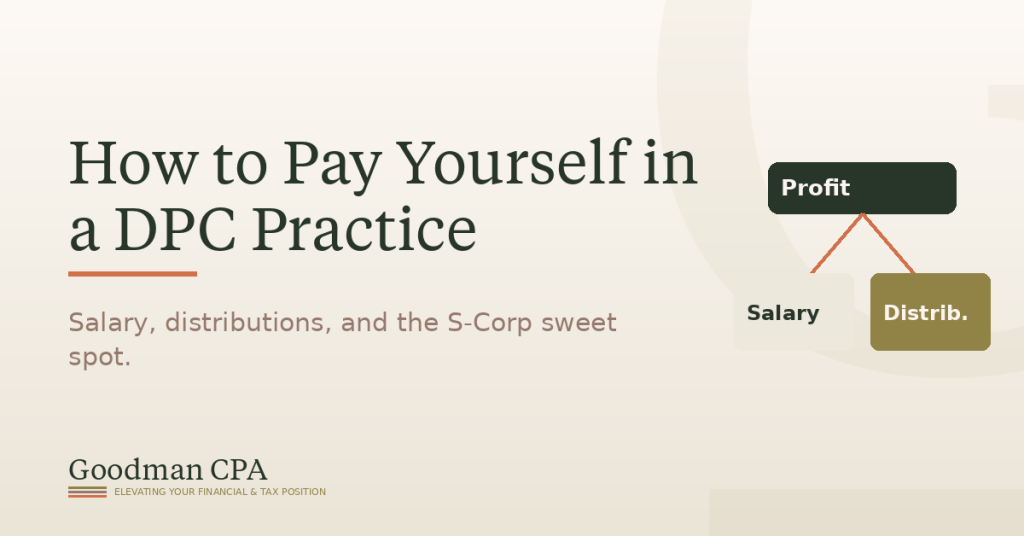
As an S-corp, you become an employee of your own business. Part of your pay comes as a salary — real W-2 wages that run through payroll, with the usual payroll taxes attached. The rest can come as a distribution — your share of the profits, taken as an owner, and not subject to the 15.3% FICA payroll tax. That distinction is the whole game: every dollar paid as salary carries payroll tax; every dollar taken as a distribution does not.
The Rule That Makes It Work: Reasonable Compensation
The IRS requires an S-corp owner-employee to pay reasonable compensation — a salary reflecting what you’d pay someone else to do your job. For a DPC physician, that’s benchmarked against what a doctor providing your clinical and administrative work would earn in your market. Within that reasonable range, every dollar you can defensibly shift from salary to distribution saves 15.3% in FICA. On a $60,000 shift, that’s roughly $9,000 a year — for a decision you make once and document properly. It’s the tax code working as designed for owners who structure themselves correctly.
The Sweet Spot: When the S-Corp Election Pays Off
For most DPC practices, the election starts making sense once net income — what’s left after expenses and a reasonable salary — lands in roughly the $60,000 to $100,000 range. Below that, payroll administration and filing costs can eat the savings; above it, the FICA savings on distributions typically outrun those costs, often by a wide margin. Many owners cross the threshold — often around $300,000 in revenue — just as the practice hits its stride. Electing at the right moment means those savings start working for you a full year sooner.
What This Looks Like in a Real Practice
Consider Chris and Becky Imperial, who run Rooted Family Health in Bryan, Texas. Over 21 months their panel grew from 560 to 770 patients, and the business was clearly working. Once we built their compensation the right way — a reasonable salary, distributions handled correctly, and the surrounding strategy layered in — they documented roughly $32,925 a year in tax savings. Ask the Imperials what the difference felt like and they don’t lead with the number. As they put it: “We would either be lost or in jail, one or the other.” That’s the real value of getting how-you-pay-yourself right — not just the dollars, but the relief of knowing the foundation is solid. Rooted’s ~$32,925 sits right in line with what we see across our client base: more than $22 million in documented savings, about $27,000 per practice per year.
The Move Worth Making Once, Correctly
Paying yourself well isn’t about squeezing your salary to the bone or chasing an aggressive number. It’s about building a structure — reasonable salary, clean distributions, the election made at the right time — that quietly returns thousands a year and lets you stop guessing. Your reasonable salary, your net-income threshold, and your ideal split depend on your market, your panel, and your numbers — which is exactly where a Direct Care–specific partner earns their place.
Let’s Find Your Sweet Spot
If you’ve been paying yourself by instinct — or you’re ready to make sure your setup is working as hard as you do — book a free Tax Strategy Session. We’ll look at your actual net income, model where your reasonable-compensation line should sit, and show you the FICA savings waiting in your own numbers. It’s the same conversation that put roughly $32,925 a year back in the Imperials’ pockets, and it starts with your real figures on the table.