
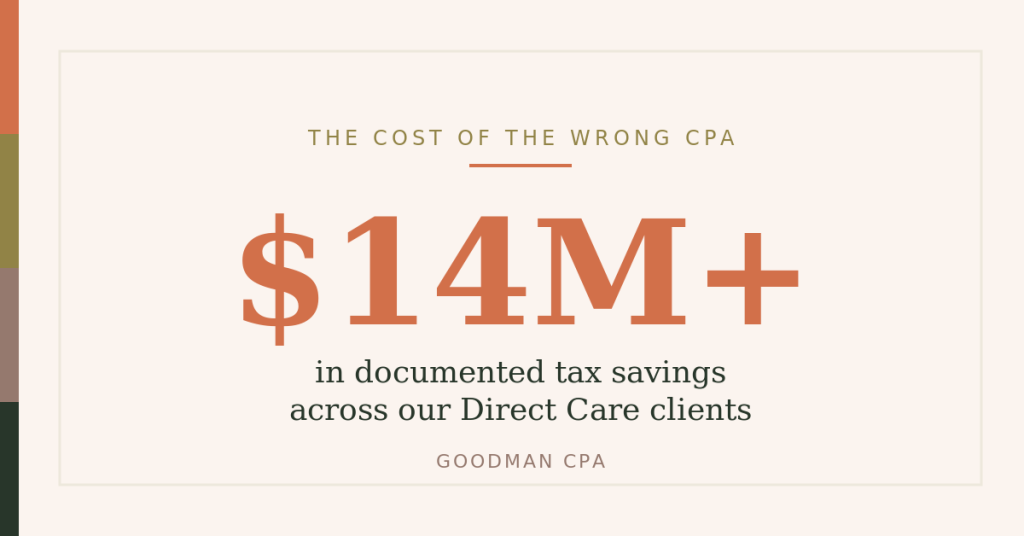
You left the W-2 grind to build something of your own. That takes real courage. Direct Care owners enjoy advantages the traditional model never offered. You don’t bill insurance. You spend more time with patients. And you’re building recurring revenue, not one-time billing. That model is a real advantage — but only if it’s structured right. The wrong accountant won’t see the opportunities coming. Think electing out of Medicare, or protecting time for new-patient visits. Finding the best CPA for DPC practices turns those opportunities into real dollars. The wrong one leaves money on the table. Across our Direct Care clients, proactive planning has produced more than $14M in documented tax savings.
What makes the best CPA for DPC practices different from a generalist
There are a few reasons to choose a Direct Care-specialized CPA over a generalist. First, a specialist earns their keep year-round. You treat them as a partner, not an April vendor. Want to DIY most of your books? A generalist for tax prep is fine. But if you want a real relationship, find a partner who shares your values.
Second, a specialist invests back into the industry. They build the resources and tools that help Direct Care practices thrive. Third, they bring cross-practice knowledge you can use in your own work. Groups like the DPC Alliance keep raising the bar for the whole Direct Care industry.
Pricing models: what you should actually pay (and for what)
This topic is close to my heart, and I think it is for many Direct Care owners too. Pricing on value is hard. What the client pays for is your time, not just a product. File once a year and the model is simple. But you leave real money on the table. You miss tax strategy. You miss advice when you need it.
Professional firms bill in different ways. Some use a retainer. You pay up front for a block of time. That’s hard to staff well without overselling. Others bill hourly, after the fact. Most owners have a story about a surprise bill they didn’t understand. It’s a lot like the traditional health care model.
Cash flow & tax strategy expertise to look for
With a value-based Direct Care accountant, you get a fractional team inside your business. They surface ways to strengthen your cash flow. Together, you apply the right tax strategies. Not sure when to elect S-Corp status? Your team helps you decide. Want to write off your home office? They set up an accountable plan. Meanwhile, your owner’s pay stays current every year. Quarterly taxes get estimated and planned, so April is never a surprise. Finally, you build reserves for emergencies.
Year-end planning: the difference proactive makes
Year-end planning then becomes a year-round habit, not a January scramble. Here’s the difference. A reactive accountant records what already happened and files it. A proactive team adjusts the plan all year. The number shrinks before the year even closes. With a plan always running, you stay compliant and ready for tax season. You’re set for your next loan. You can hire with confidence. The results are real. Wellspring DPC saved $30,907 in one year while growing 148%, because the planning never stopped.
Questions to ask before you hire
Some great questions we always have people ask when they are trying to compare quotes from CPA firms and accounting practices.
- What is your policy for response time?
- Can you show me how much I can save on taxes — or at least estimate it — before I start working with you?
- Can you tell me your process for onboarding clients and do you have any results I can look at from other clients to know you have had success.
How to choose the right one for your stage
Depending on your stage in the business here’s the next step I recommend:
- De Novo (Start Up) – you should find a partner that can help you make good foundational business decisions and get you set up with some training to DIY part of your business and learn it then be ready to hand off
- If you’re established (1–2 employees, ~$200K in membership income), you should be looking to offload your accounting to a fractional team that works alongside you in the business — handling the monthly accounting, meeting with you for business planning each year, and managing tax strategy and prep.
- If you’re scaling (2–100 employees, ~$1M in revenue), you want someone who can help you model out adding locations, making key hires, and adding benefits, and who can act as a liaison with banks and other partners.
Closing CTA
Wondering what proactive planning could save your practice? Book a free Tax Strategy Session with our Direct Care Accounting team, and we’ll show you the opportunities a generalist is missing — before you ever commit.