

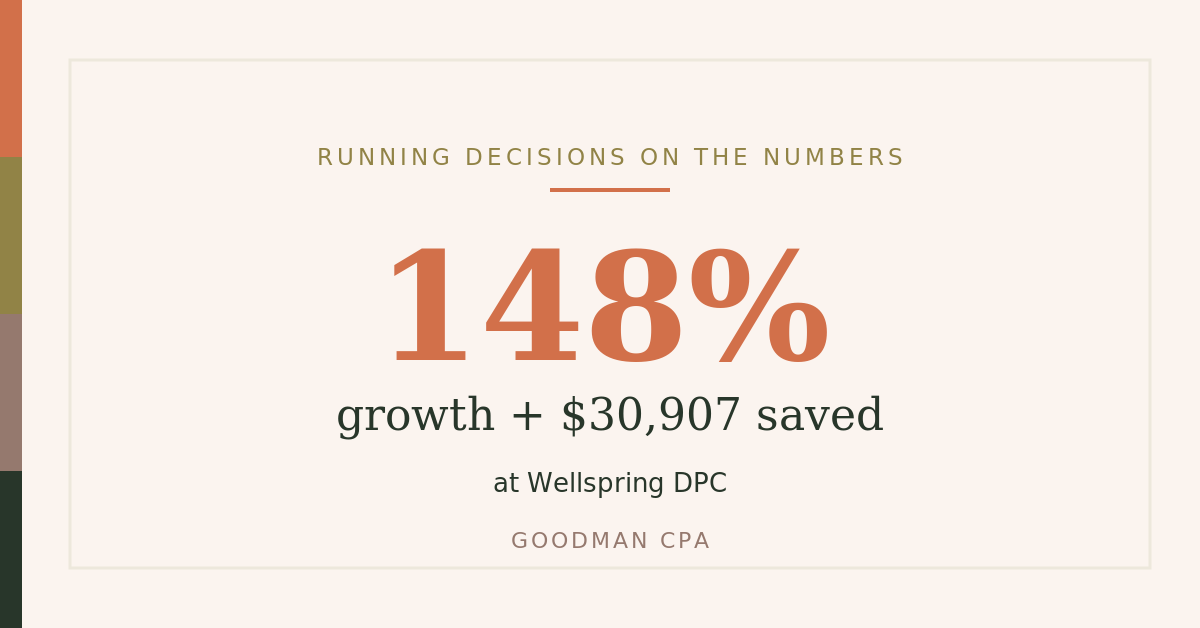
More members feels like growth. It is not always. In a subscription practice, the top line can climb while your take-home shrinks. The headline number hides the truth. To know if you are really growing, you read the right DPC financial metrics. Four of them, specifically. Wellspring DPC grew 148% and saved $30,907 last year. That did not come from guessing. It came from running every decision on these four numbers. The best part? You already have them.
Why top-line revenue lies in a subscription model
Revenue is the number everyone watches. In DPC, it is also the most misleading. New members can mask churn. A price increase can hide rising costs. Distributions can feel like profit when they are not. None of that shows up on the top line. So a growing revenue figure can sit on top of a shrinking business. The fix is simple. You read a few more numbers, and you read them often.
The four DPC financial metrics that actually matter
You do not need a finance degree to do this. You need four numbers and a habit of checking them. Here is what each one tells you, and why it matters mid-year.
1. Recurring-revenue trend and net member growth
Start with momentum. Are you adding more members than you lose? Net member growth is the cleanest read on real demand. Track it month over month. A rising trend means the engine is working. A flat one is a quiet warning, even if revenue looks fine.
2. Owner pay vs. distributions
This is your true take-home. Salary and distributions are not the same thing. Owners often blur the two and lose track of what they actually earn. Separate them. Then you can see your real income, and you can plan your taxes around it. Guessing here is expensive.
3. Operating margin and cost per member
Margin tells you how much of each dollar you keep. Cost per member tells you why. Together, they show whether growth is profitable or just busy. Watch them as you scale. If margin slips while members climb, you are growing the wrong way.
4. Cash on hand and runway
Profit is not cash. You can be profitable on paper and still feel tight. Runway is the number of months you could cover from cash today. Know it. A healthy runway lets you hire, invest, and ride out a slow month without panic.
How to read your DPC financials in ten minutes
All four numbers live on one monthly statement. You do not need new software. You need the report and a quick routine. Pull your profit and loss and your balance sheet each month. Find the four numbers. Write them down. Compare them to last month. That is the whole habit, and it takes about ten minutes.
What the four numbers look like together
One number alone can mislead. Together, the four tell a story. Say your membership is climbing and your margin is holding. That is healthy, durable growth. Now say members are flat but your cash runway is shrinking. That is a signal to act, not panic. Or imagine revenue up while owner pay is down. That usually means your structure needs attention, not more patients. The pattern matters more than any single figure. So read them as a set, every month. Over time, you spot trouble early and opportunity sooner. That is the difference between running your practice and reacting to it. It is also how a good month quietly becomes a good year.
Why mid-year is the moment to look
Mid-year is the perfect time to read these numbers. You have six months of real data, not a forecast. You also have six months left to act on what you find. That balance is rare. In January, you have a plan but no results. In December, you have results but no runway to change them. July gives you both. So treat this as your financial checkpoint. Pull the four numbers now, while small adjustments still have time to compound. A modest price increase in July works for half a year. The same increase in December barely moves the total. A staffing decision made now plays out over two quarters, not two weeks. Reading early is not about more work. It is about giving each decision room to pay off. The owners who build this habit stop guessing and start steering. They walk into year-end calm, because nothing on the statement surprises them. That calm is worth as much as the savings.
None of this requires fancy tools or a finance background. It takes a few minutes and a willingness to look. Read the four numbers every month, and the story of your practice becomes obvious. From there, the right moves are usually clear.
Turn the numbers into Q3 and Q4 decisions
Numbers only matter if they drive action. Member growth strong but margin slipping? Raise prices or trim costs. Take-home unclear? Fix your pay structure before year-end. Runway thin? Slow your hiring for a quarter. This is the CFO lens, and it is exactly how Wellspring DPC turned 148% growth and $30,907 in savings into a plan instead of a surprise. A fractional CFO can run this with you every month.
Want help reading your own numbers? Book a free Tax Strategy Session, and we will walk through your DPC financial metrics together. You can also see how our tax advisory and fractional CFO services fit a growing practice. Stop guessing whether you are growing. Start reading the four numbers that prove it.