

As a business owner, you've probably heard about tax deductions and tax credits—those alluring terms that can reduce what you owe the IRS. But do you really understand how they differ, and more importantly, how to use them strategically to benefit your business? Many entrepreneurs lump these two concepts together, but they work in fundamentally different ways that can significantly impact your bottom line.
How Tax Deductions Work: Reducing Your Taxable Income
Tax deductions lower your taxable income—that is, the amount the government uses to calculate how much you owe. Think of it like trimming down the size of the pie before taking a slice. For small business owners, deductions typically come from legitimate business expenses: your office rent, employee salaries, equipment purchases, and other costs of doing business.
Consider Dr. Smith, who runs a direct primary care practice. His clinic pays $3,000 monthly in rent ($36,000 annually) and spends another $24,000 on medical supplies and staff salaries. These $60,000 in deductible expenses reduce his taxable income from $200,000 to $140,000. At a 24% tax rate, this saves him $14,400 in taxes.
That last caveat is important— in a progressive tax system the value of deductions depends entirely on your tax bracket. For instance, that same $60,000 deduction would only save around $7,200 for someone in the 12% bracket. The reason for this is that deductible expenses are subtracted from the ‘top’ of one’s earnings (meaning that there is less income to be taxed at the highest marginal tax rate). This is why high-earning professionals and businesses often benefit more from deductions than individuals or smaller operations.
How Tax Credits Work: Direct Dollar-for-Dollar Savings
While deductions reduce the income you're taxed on, tax credits directly reduce your actual tax bill, dollar for dollar. A $1,000 tax credit means you pay $1,000 less in taxes, regardless of your income level or tax bracket. Some credits are even refundable, meaning you could get money back even if you don't owe anything.
Let's look at a real example. A small medical software company spends $75,000 developing a new patient management system. They qualify for the Research & Development (R&D) Tax Credit, which gives them 20% back—i.e., a $15,000 direct reduction in their tax bill. Unlike deductions, this benefit isn't tied to their tax bracket. Whether they're in the 12% or 37% bracket, they still save the full $15,000.
Other valuable credits for small businesses include the Work Opportunity Tax Credit (WOTC) for hiring from certain disadvantaged groups (worth up to $9,600 per qualifying employee) and energy efficiency credits for making green upgrades to your business property.
The Critical Differences (And Why They Matter)
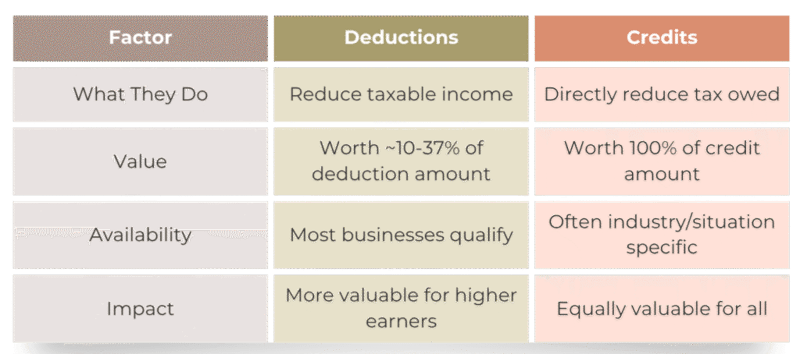
This table highlights why credits are generally more powerful than deductions. A $10,000 deduction might only save you $2,400 (if you're in the 24% bracket), while a $10,000 credit saves the full $10,000 regardless of your income.
However, credits often come with more restrictions. The R&D credit only applies if you're developing new or improved products/processes. The WOTC only applies when hiring specific types of employees. Deductions, on the other hand, are more universally available for ordinary business expenses.
Strategic Tax Planning for Maximum Benefit
The smartest approach combines both deductions and credits strategically. First, ensure you're capturing all your legitimate business expenses as deductions. Then look for opportunities to qualify for credits that fit your business activities.
Many business owners miss out because they don't realize certain activities qualify. That software developer writing code for your website? Might qualify for R&D credits. The energy-efficient HVAC system you installed? Could qualify for green energy credits. Even hiring summer interns from certain programs might make you eligible for workforce credits.
The key is documentation. Credits often require more paperwork than deductions. For the R&D credit, you'll need to document what made your research innovative. For energy credits, you'll need specifications and certifications for your equipment. This is where working with a knowledgeable CPA like Goodman pays dividends; they can help identify opportunities you might miss and ensure you have the proper documentation.
Putting It All Together
Understanding the difference between deductions and credits is about more than just understanding tax jargon—it's a financial strategy that can save your business thousands. While deductions are valuable for reducing your taxable income, credits offer direct dollar-for-dollar savings that can have an immediate impact on your bottom line.
The best approach is to maximize both. Track all your business expenses carefully to claim every deduction you're entitled to, but also look strategically at how your business activities might qualify for various credits. And remember, tax laws change frequently. What didn't qualify last year might qualify this year, making an annual review with your CPA a smart investment.
At Goodman CPA, we specialize in helping small business owners and medical practices navigate these complexities. We don't just prepare your taxes—we look for every legitimate opportunity to reduce your tax burden through smart application of both deductions and credits. Why leave money on the table when strategic tax planning can put it back in your pocket?
Talk to us and find out how we can help you make the most of tax season.